

Future Chronicles: An Algorithm of Our Own
Future Chronicles: An Algorithm of Our Own
Curated and hosted by Karen Palmer, Storyteller from the Future
In collaboration with Black Rhino VR
Supported by the British Council as part of the UK/Kenya Season
I didn’t come back from the future alone. I came back with a transmission — and with a tribe.
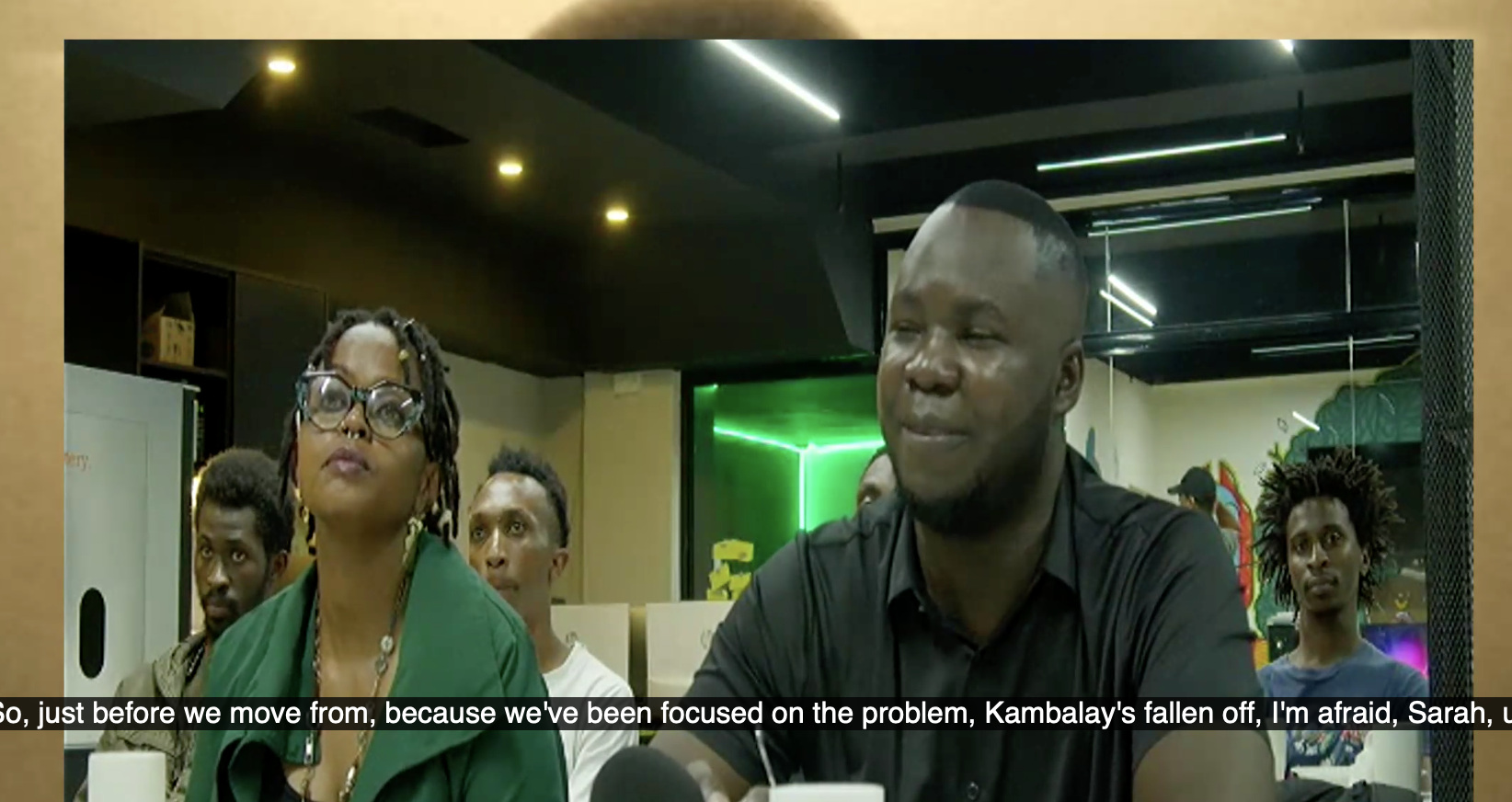
This wasn’t a panel. It was a coded gathering. A live convergence of technologists, Indigenous knowledge holders, ethicists, artists, and system architects — people carrying seeds for new futures. Together, we cracked open the question:
What if we designed intelligence from the soul outward — not from the server in?
We tuned in from Nairobi, London, Lagos, New York — but this wasn’t about location. It was about frequency.
From the first moment, you could feel the shift. The nervous system responded before the brain had time to catch up. People wrote in the chat:
“My whole body just responded.”
“I didn’t expect this — I needed it.”
“I feel like I just got my Source Code back.”
That’s the work. That’s what happens when you stop trying to fix a broken system and start building from a deeper signal — the one we’ve always had but were told to forget.
The speakers weren’t just guests. They were co-conspirators.
Wakanyi Hoffman spoke on Ubuntu as more than a philosophy — as protocol, as lived technology.
Mophat Okinyi flipped the idea of data ownership and asked what it would mean to care for data the way we care for elders.
Kambale Musavuli connected the cobalt in our devices to the colonial logic still embedded in AI’s supply chain.
Taylor DeClue reminded us that this isn’t a content war. It’s a soul war.
Mario Marquez cracked the system open and spoke to building new languages where old systems can’t hear us.
Rex Lee dropped fire on the urgent need for an Electronic Bill of Rights.
And Black Rhino VR grounded it all in creative resistance — immersive storytelling as cultural memory and future-claiming.
Every single one of them brought a piece of the code.
This space was never meant to be consumed — it was meant to activate. It didn’t just raise awareness. It rewired perception. It was story as technology. Community as OS.
And now, people are asking what comes next:
“Can this be a series?”
“Can we bring this into institutions?”
“Can we use this as a tool for training, learning, imagining differently?”
Yes.
That’s exactly the point.
This is a prototype. A signal.
Future Chronicles is part of something much bigger — a larger ecosystem of immersive tools, labs, and living systems that reimagine AI through story, spirit, and agency.
If you’re reading this, you’ve already heard the signal.
If you want in — come correct.
Not just with credentials, but with alignment.
Let’s make the next iteration together.
Let’s write the algorithm of our own.
I’m Karen Palmer — and this is only the beginning.


Diriyah Art Futures
Ascended Intelligence
Storytelling as Spirit. Storytelling as Ascension.
Diriyah Art Futures marks a turning point. A shift in frequency. It’s the moment where Storyteller from the Future pivots — from warning about surveillance and control to activating the systems that come next.
As Wakanyi would say, this is Ubuntu.
As Mophat would say, this is stewardship.
Through my lens — this is storytelling as spirit.
Storytelling as ascension.
Storytelling as ritual.
Storytelling as transformation.


With Ascended Intelligence, we use immersive storytelling not to simulate crisis — but to amplify our humanity.
My earlier works like Consensus Gentium used your gaze to reflect how the system sees you. But this? This work listens. It listens to your voice, to your tone, to your frequency. It responds to your presence.
Because in a world flooded with AI outputs, the deepest technology we have is still the human being. And the stories we tell are not just narratives. They’re mirrors. They show us who we’re becoming — and what else we could be.
Presenting this work in Saudi Arabia, at Diriyah Art Futures, was not just about location — it was about alignment. When I arrived, even in the quietest spaces — through the people, the language, the land — I could feel something spiritual. Something rooted. A presence.
That presence shaped the work. This wasn’t just about interacting with tech. It was about sensing the environment — the dust, the rhythm of breath, the energy in the stone. It was about building a system that responds not only to voice, but to the truth of being there.
Diriyah was my first creative connection in the Gulf region — a relationship I hope is just beginning. But even in that first chapter, something deeper came through:
This is not about spectacle.
It’s about source.
It’s about building sacred technology that helps us remember — and recalibrate.
Ascended Intelligence is the ritual architecture for what comes next.
Annwn Prize
Consensus Gentium shortlisted for the inaugural Annwn Prize for Excellence in Immersive Storytelling
I wasn’t trying to predict the future.
I was trying to help people realize it’s already here — embedded in our choices, interfaces, and blind spots.
Immersive futures aren’t entertainment — they’re warnings in the form of experience.
I am honoured that Consensus Gentium - my interactive AI film exploring digital ID, surveillance and emotional autonomy - has been shortlisted for the Annwn Prize, a new global award recognising visionary immersive storytelling that puts people, not platforms, at the centre.
Presented by Wales Millennium Centre and Crossover Labs, this prize lands at a very specific moment in history. The systems Consensus Gentium was warning about when I first created it are no longer speculative. They are quietly becoming our day to day reality.
Consensus Gentium began as an act of speculative resistance. You step into a near future where your gaze, micro-expressions and emotional state are monitored by an AI driven Global Citizen App. You are simply trying to visit your sick Nana, but every facial twitch is read as a signal of compliance or dissent.
It was satire.
It was a glitch.
It was a mirror.
Now it is no longer a future.
We are living in the timeline the piece was trying to warn about.
That is why this recognition from Annwn matters so much to me. Not just as an accolade, although I am grateful for it, but as confirmation that the work still meets this moment with the urgency, sensitivity and uncomfortable honesty it was built for.
To receive this alongside previous honours - the SXSW XR Jury Award, the Digital Dozen Breakthrough Award, Ars Electronica’s Honorary Mention and a Special Mention from Cao Xing XR - is humbling. It tells me that this story keeps echoing. That the global hum is real. That the work has a pulse.
But for me, this is also about responsibility.
Years ago, at a cold conference in Moscow, an LA professor said something that stayed with me: art does not change the world on its own, it becomes the catalyst for the conversations that do. That sentence has shaped how I work.
I do not create immersive pieces so people can escape reality. I create living systems that pull reality into the room, so we can finally talk about it.
That is why, in the spirit of my live performance at the Roundhouse, I am developing a special live iteration of Consensus Gentium for this next chapter. The world of the app will spill out into the physical space, as if you are standing on the film set of the immersive experience itself. The aim is simple and serious: to move Consensus Gentium from something you watch, into something you stand inside, think inside and argue inside.
As Storyteller from the Future, I carry that role with care. I do not just build immersive art. I build environments that help people recognise their own agency, even when the world insists they do not have any.
At a time when digital systems are tightening their grip, when emotional data is the new currency and when urgency is often buried under spectacle, I choose to create experiences that cut through the noise, bring people back to their bodies and remind them that they are not just data points in someone else’s model.
To have Consensus Gentium recognised by Wales Millennium Centre, a space with deep cultural memory and mythic resonance, is not a small thing. Because what I am building is not just commentary. It is ritual. It is a place to confront what is happening and decide who we want to be inside it.
This shortlisting is a moment of reflection. A signal that this work is doing what it was always meant to do:
not just to be seen,
but to be felt,
to be debated,
and to be lived.
It is not just a film.
It is a future you can experience
before it writes itself into your code.